Tips for Sparking New Ideas

Image by Clker-Free-Vector-Images from Pixabay

Linus Pauling, who won the Nobel Prize in Chemistry in 1954, and the Nobel Peace Prize in 1962, once said: “The best way to have a good idea is to have a lot of ideas.”

It sounds like a simple strategy, but it turns out to be a great deal more difficult than it sounds. Here are a few ways you can try to increase your capacity to come up with new ideas.

New ideas require looking at problems or challenges from a different perspective. This can help you see relationships you may have previously thought unlikely. This is known as associative thinking. Associative thinking is a crucial component of using asset-based approaches to creating change. As you uncover people’s skills, relationships, and talents, the best ideas often emerge by considering how to connect two or three seemingly unrelated assets. This skill is at the core of creative leadership.

If you survey all of the capacities you have to leverage, you have to be willing to identify potential relationships between things which at first glance appear to be unrelated. Then ask yourself, “What if?”

Appreciative Inquiry is another good way to stumble upon new ideas. Generative dialogue serves to create community by forming new relationships. It also generates ideas with a future focus. Asking questions always yields new ideas because every person will have a unique response to a question (Read more about Appreciative Inquiry here).

Songwriters are often asked whether they start with the lyrics, or the melody. Their responses remind us that songwriting is not necessarily a rigid process. Sometimes it is a single lyrical phrase. Other times it is the tiniest piece of a chorus. A common thread among many songwriters, however, is that they write down these bits and pieces as soon as they come to them, or maybe record a short voice message to return to later. This is a good habit.

Ideas can be fleeting. Make some type of note that you can return to. Some creative people keep a notepad at their bedside. As they lay down, and the noise of the day begins to clear their mind, a moment of clarity can reveal itself. They write their insight down, so it doesn’t get lost.

Finally, remember that not all ideas are gems. Two or three bad ideas might simply be covering up a magnificent one. Ideas hide in serendipity. They can come from deliberate attempts, but they can also be happy accidents. So keep your eyes and ears open.

Embrace Curiosity

Illustration from Edwin D. Babbitt’s The Principles of Light and Color, 1878, (public domain)

“… what you learn today, for no reason at all, will help you discover all the wonderful secrets of tomorrow.”

Norton Juster, The Phantom Tollbooth

After publishing my recent post, “Five Quotes About Listening,” I began to think more about the relationship between listening and curiosity. I started to think that curiosity might possibly be the most important leadership trait. It creates relationships and is a key to both social and emotional intelligence. It feeds innovation and informs shared vision (you have to be curious about what an alternative to the status quo might look like in order to make it happen). Without curiosity, we can get locked into inaction by a sense that the familiar is an absolute, immovable reality.

Without curiosity, mysteries and crimes would never be solved. Novels could not be written. Curiosity inspires learning, and discovery. Without it, there would be far fewer scientific discoveries. Scientists will tell you that the laboratory isn’t just a series of “eureka” events. More often than not scientists will look at some result in their lab and say, “hmm, that’s weird.” Curiosity is sparked. Discoveries are made.

Years ago, I was working on a writing project. I had been researching the life of a woman who had accomplished some amazing things as a teenager in the early 1930s. She had passed away, but one of the people I interviewed told me that the subject of my research had a younger sister who was still alive, and that she would be happy to introduce us. This was a tremendous opportunity.

I prepared a list of eight to ten questions to ask the younger sister. On the day of the interview, I got to the third question, and her answer introduced ideas I had not considered. My curiosity told me to go down the path the sister was taking me, rather than the path that would fill the gaps of the story I had thought would be important to tell. As a result of remaining curious about the direction the sister led me, my understanding of the story I wanted to tell became deeper, more nuanced, and compassionate.

Curiosity makes you dig deeper. It can bring additional clarity to positions you already hold. But it can also give you the courage to change your mind.

Curiosity is a prerequisite for creative leadership, and continuous learning. Being a leader doesn’t mean that you know everything. It means that you are always on the lookout for context, lucidity, and insight. Curiosity allows you to see the world through many different lenses. Be curious.

The Importance of Imagination in Creating Change

Image by Alexandr Ivanov from Pixabay

“Imagination is everything. It is the preview of life’s coming attractions.”

Albert Einstein

Humans will never fly. Television is just a fad. Who would ever need a computer in their home, much less carry one around wherever they go? Some people have trouble picturing a different future. Imagination allows you to see changes that others cannot. It can also help to forge a path to those changes.

So many of the topics that I have written about here illustrate the importance of imagination. Having an imagination is essential. Imagination helps turn ideas into actions. It is a key to problem solving. You have to be able to imagine a solution to a problem you are trying to solve.

The ability for any group of people in search of a better quality of life, to create a shared vision of what changes they will have to work toward, requires imagination. Maintaining the hope, or the expectation that your shared vision is possible requires that you be able to imagine a better world. When you ask someone to keep their “eyes on the prize,” you are reminding them to imagine that improved life.

One way to discover creative strategies and solutions is to seek out creative people. Who is creating art in your community? Who is managing to do great work with seemingly very few assets? The most imaginative people may not be in your usual circle of acquaintances. You may have to look at the margins. Find the people who are otherwise invisible. Find these imaginative people and listen to what they have to offer. As George Bernard Shaw put it, “Imagination is the beginning of creation. You imagine what you desire, you will what you imagine and at last you create what you will.” (For more on creativity and leadership see, “Traditional Versus Creative Leadership.”)

If imagination is so important, why is it then that so many people say that they don’t really have much imagination? This isn’t a problem with children. Kids will frequently remind you of their capacity to imagine. They also often turn that imagination into creative works. Many adults, however, apparently lose their imagination mojo.

In the 1940s an advertising executive named Alex Osborn (He’s the guy who coined the term, ‘brainstorming’), recognized that this lack of adult imagination was a problem, so he came up with something he called, “creative problem solving.” The idea is that imagination can be cultivated and nurtured. You can read more about it here.

I have written previously that the world is not simply made up of two groups: your allies, and those opposed to your ideas. A great number of people are simply unaware that your issue is even a problem. The need to attract attention to the change that you are trying to create requires imagination. With all the ideas competing for our attention, imaginative, fresh messages stand a better chance of being heard.

More Resources

The Importance Of Imagination – Tao de Haas
6 Proven Benefits of Being More Imaginative – Mental Floss
This is how to harness the power of human imagination for social change – World Economic Forum

Traditional Versus Creative Leadership

“The role of a creative leader is not to have all the ideas; it’s to create a culture where everyone can have ideas and feel that they’re valued. So it’s much more about creating climates. I think it’s a big shift for a lot of people.”
– Sir Ken Robinson

traditional vs creative leadershiptable: John Maeda and Becky Bermont/Redesigning Leadership

A creative leader is able to bring out the creativity of other people. It is the opposite of “do as I say, not as I do” leadership. More than other types of leadership, this is really about cultivating an organizational culture that supports and values creative thinking and problem-solving.

A survey of over 1,500 CEOs, conducted by IBM found that creativity is the most important leadership quality. Flexible, open-minded leaders rely on creative problem-solving at some level every day.

According to Sanjay Dalal, CEO & founder of the website Ogoing, the top three characteristics and traits of creative leaders are:

“1. Great at generating many ideas – innovative, game changing and even commonplace.
2. Always looking to experiment with good ideas. Sometimes, trying out a few times.
3. Unwavering belief in their creativity and innovation, coupled with originality in thinking.”
See more at http://creativityandinnovation.blogspot.com/2007/01/top-ten-creative-leadership-traits.html

Creative leadership isn’t just about generating novel ideas or approaches; it actually changes systems. Travis N. Turner notes that, “creative leaders tend to pursue revolutionary strategies (that reinvent the system) rather than the incremental strategies (that improve the existing system).” For this reason I believe that it is more than a fad, or a “flavor of the month.”

Strategic thinking is inherently creative thinking. Leaders are continuously imagining how events will unfold. They are developing contingencies based on the reality that things are not always predictable.

An article by consultant Charles Day, in Fast Company magazine listed the “four weapons of exceptional creative leaders.” You can see how his list includes a number of ideas we have explored already. Day’s list includes:

  • Context – Context is built from the future back, based on the best current information. Understanding context requires both knowledge and imagination.
  • Clearly Defined Values – Shared values are the heart of an organization’s culture. Creative leaders realize that this arises from conversation and discovery, and not from orders or memos.
  • Trust – Eric Hoffer said, “Someone who thinks the world is always cheating him is right. He is missing that wonderful feeling of trust in someone or something.” Be creative. Imagine how you are going to establish and maintain trust among your stakeholders.
  • Momentum – According to Day, “Innovation is the consequence of exploration. And you can’t explore while standing still.” Nowhere is creativity more important than in creating and maintaining momentum.

There is much more to say about this (design, process, developing creativity skills, . . .), so more on this topic later.

Entrepreneurs Versus Administrators

“Entrepreneurs may be brutally honest, but fostering relationships with partners and building enduring communities requires empathy, self-sacrifice and a willingness to help others without expecting anything in return.”
– Ben Parr

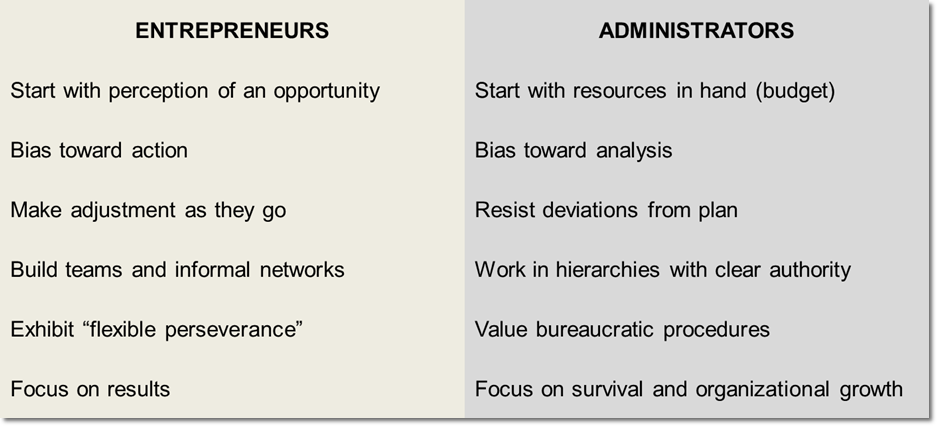
Administration of any institution is essentially a conservative practice. Entrepreneurship, on the other hand, is progressive by definition. When you look at Greg Dees’ table below, the idea that jumps out is that administrators are essentially risk averse. Of course, when no risks are taken things don’t change a whole lot. It isn’t that entrepreneurs don’t try to mitigate risk; they simply embrace it as part of the price you pay to innovate.

entrepreneur vs administratorSource: J. Gregory Dees, Co-founder, Center for the Advancement of Social Entrepreneurship (CASE), Duke University’s Fuqua School of Business

Consider the value in entrepreneurship’s bias toward action, combined with flexible perseverance. This the best recipe for creating change. Bureaucratic administration is the best recipe for maintaining the status quo.

There are certainly enterprises that need to be rooted in bureaucratic procedure. If your goal is to create something new, and different, however, you may want to consider entrepreneurial approaches.

How can leaders foster and cultivate entrepreneurship?

  • Encourage creativity. Crowdsource your challenges among your team and allies.
  • Continually experiment with small “proof of concept” pilot projects. Don’t just talk about doing things differently; try something new.
  • Play the devil’s advocate when plans appear to follow the way things have “always been done.” Just make sure that you don’t let questioning everything keep you from action.
  • Don’t be too prescriptive, and encourage ownership of your goals. People will see various paths to achieving outcomes.

It seems that to a great extent, administration is about power, and mitigating risk. Continue the exploration of those topics by clicking the links.