Narrowing The Gap Between Our Ideal And Our Real Values

“The whole idea of knowing who you are and what you stand for is so simple, yet also so profound and sophisticated. It’s difficult to pull off, but without it there’s no chance to institutionalize the vision and make it long-term and lasting.”
-Bob Boylan

Positive change usually happens after people have: 1) examined and understood their values; 2) articulated a shared vision after identifying their common values; and 3) strategically leveraged their own strengths toward achieving their common goals.

One big barrier to change is the fact that most people don’t spend a great deal of time analyzing their values. Your values are your principles, your personal standards of behavior. They tell people what you believe is important in life; and they indicate to others what you have in common at the deepest human level.

Examining your values is important because they become clear over time. They are not static; they change as you grow personally, establish relationships, and life experience. As you consider your values, it becomes apparent that some feel more personal than others. These might be called realized, or real values. The ones that seem like they have less to do with you personally are ideal values. They are things like freedom, democracy, and fairness.  You know that you should value them, and you don’t spend much time thinking that other people might have wildly different understanding of what they mean.

Despite these differing interpretations, ideal values are considered absolute. They are written into law. Real values help to resolve the contradictions between ideal values and people’s everyday behavior.

The Gap, the Contradictions, and the Conflicts

“The shepherd drives the wolf from the sheep’s throat, for which the sheep thanks the shepherd as a liberator, while the wolf denounces him for the same act as the destroyer of liberty, especially as the sheep was a black one. Plainly the sheep and the wolf are not agreed upon a definition of the word liberty.”
-Abraham Lincoln

If you asked any 100 people in your community if any children in your town should be going to bed hungry, I would guess (and hope) that they would all express that having no undernourished children is a community value. If everyone shares that value, why are children going to bed without enough to eat? It probably isn’t a disagreement about the definition of hunger or malnutrition that is the barrier to coming up with the political will to do something to address the problem.

The gap between the ideal and real value isn’t simply the fault of individuals. Many people would act if they knew what actions they could take. This is where leadership comes in. Leaders can help individuals understand how their real values, things like justice, empathy, community, etc., can inform a strategy to solve the challenges of making sure that people have enough to eat.

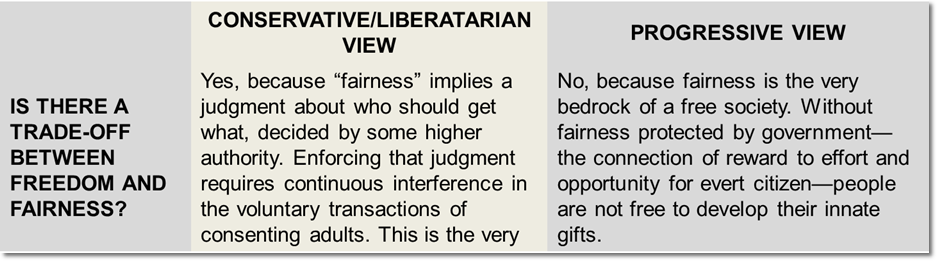
Democracy is a commonly expressed ideal value. If we all believe in democracy, why is voter turnout not 100%? Is it just the IDEA of the ideal value that is important, or are people willing to act on their common values? The table below begins to illustrate why narrowing the gap is not an easy task. It shows how people might have opposing ideas about something perceived as an ideal.

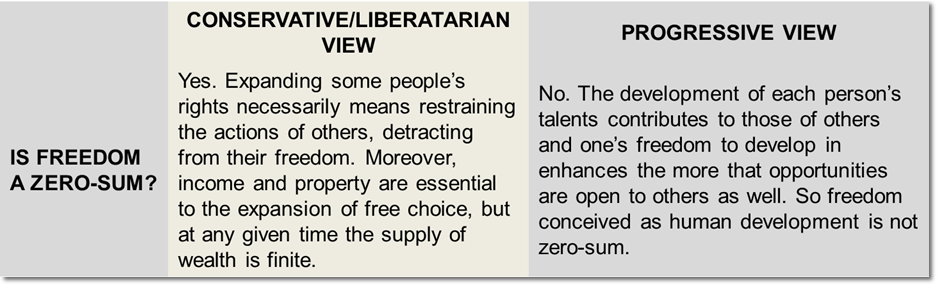
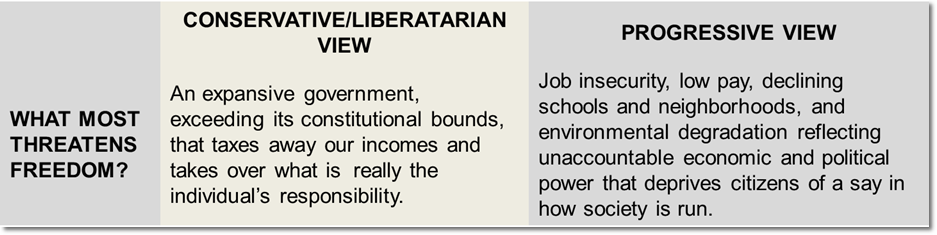
The tables below are based on Frances Moore Lappe’s insightful book, Rediscovering America’s Values. In the book, Lappe explores the nuances of some ideal American values. Here are just a few of the competing ideas she presents relating to freedom.
freedom1freedom2freedom3Despite differing views on these values, how do we work to find common ground? What steps can people take to help narrow the gap between ideal and real values? Dr. Greg Waddell suggests four things in particular:

  1. Reward what you value.
  2. Measure what you value.
  3. Model what you value.
  4. Design life experiences of what you value.

Think about these four actions as they relate to a personal value. How do you consciously live your values? More on values to come.

Quality Of Life Versus Standard of Living

“The quality of life is more important than life itself”
-Alexis Carrel

The terms quality of life, and standard of living, are often used interchangeably. Standard of living is for the most part, a measure of consumption. Money, however, cannot buy happiness. It can’t keep people from discriminating against you. It can’t make you as young as you used to be.

quality of life vs. standard of living

An article by Cornelia Butler Flora, published by the North Central Regional Center for Rural Development, cites a NCRCRD study “relating the objective measures with subjective measures of quality of life.” Among the the findings of that study:

1. Quality of life is not related—either positively or negatively—to standard of living.
2. Having choices in the productive work that you do is the most important dimension of quality of life.
3. The respect of family and people who matter to you in your communities of place and interest is the second key dimension of quality of life.

This is important to understand if you are trying to innovate some change in the world. Even though quality of life is subjective, and means different things to different people, there are many values and dreams that are shared among many individuals, and groups in a community. One of the important things that leaders can do is to work toward achieving satisfaction with quality of life throughout their organization or community. People make up their minds on issues based on how those issues impact their own quality of life.

This does not mean that standard of living indicators are not important. It just serves as a reminder that many, many of our desires transcend money and wealth.

I once worked with a leadership group in a small, scenic community that was staring the quality of life/standard of living question smack dab in the face. This small town had a resident who was proposing to build the nation’s largest tire incineration plant. He was selling the idea primarily on the idea of job creation. His claim was that burning the nation’s used tires would improve the local economy, improving the standard of living for low level wage earners.

Of course, the opposition to this plan came from citizens whose arguments were rooted in quality of life issues. Air quality, ecosystem destruction and aesthetics,eventually won the day, but not before the community experienced considerable divisiveness, trying to reconcile their common values.

There can be no community development without economic development; and there can be no economic development without talking about quality of life concerns.

Fixed Versus Growth Mindset

“If, like those with the growth mindset, you believe you can develop yourself, then you’re open to accurate information about your current abilities, even it it’s unflattering. What’s more, if you’re oriented toward learning, as they are, you need accurate information about your current abilities in order to learn effectively”
― Carol S. Dweck, Mindset: The New Psychology of Success

We need to be aware that we have ideal mindsets, and real mindsets. Even though we like to believe that we embrace growing and learning, fixed mindsets contribute greatly to keeping us from accomplishing goals. The comparison below is based on Carol S. Dweck’s 2006 book, Mindset: The New Psychology of Success.

mindsetLike so many of the ideas we discuss here, changing your mindset requires courage. We are afraid to fail. We are afraid of criticism. It’s pounded into us from an early age.

Leaders can help people bolster their courage. Ways that you can help others (and yourself) to overcome fear, and demonstrate more courage include:

  • Build confidence – Try to capture the feeling of confidence that you have when you are inside your “comfort zone.”
  • Wade outside the comfort zone – Know personal limits, and start small. It is always easier to face the things you fear when you are with someone else. Be there with people when they take those baby steps toward facing their fears. When you get to the uncomfortable place . . .
  • Avoid hesitation – Don’t allow for more time to come up with excuses. Accomplish something small, and then lock that success away to bolster your confidence next time.

Responsibility

“We are made wise not by the recollection of our past, but by the responsibility for our future.”
— George Bernard Shaw

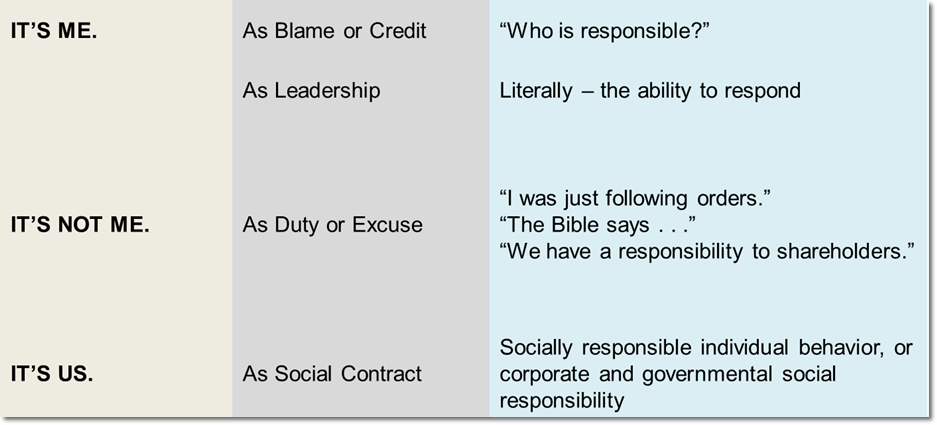
I created the table below to illustrate a few of the ways that people think about responsibility. The first use actually address the difference between responsibility and accountability. Accountability is liability, and demands some sort of response. You can be responsible by being accountable.

ResponsibilityThe “it’s not me” notion of responsibility is often used as the excuse for not doing the right thing. It often takes courage to avoid using this excuse, because it can mean risking an asset or a privilege that you currently have.

To think of responsibility as a social contract is supposedly what we are doing in a democracy. Of course, the idea that democracy is primarily about competition rather than cooperation often keeps social responsibility from being a primary consideration.