Traditional Versus Creative Leadership

“The role of a creative leader is not to have all the ideas; it’s to create a culture where everyone can have ideas and feel that they’re valued. So it’s much more about creating climates. I think it’s a big shift for a lot of people.”
– Sir Ken Robinson

traditional vs creative leadershiptable: John Maeda and Becky Bermont/Redesigning Leadership

A creative leader is able to bring out the creativity of other people. It is the opposite of “do as I say, not as I do” leadership. More than other types of leadership, this is really about cultivating an organizational culture that supports and values creative thinking and problem-solving.

A survey of over 1,500 CEOs, conducted by IBM found that creativity is the most important leadership quality. Flexible, open-minded leaders rely on creative problem-solving at some level every day.

According to Sanjay Dalal, CEO & founder of the website Ogoing, the top three characteristics and traits of creative leaders are:

“1. Great at generating many ideas – innovative, game changing and even commonplace.
2. Always looking to experiment with good ideas. Sometimes, trying out a few times.
3. Unwavering belief in their creativity and innovation, coupled with originality in thinking.”
See more at http://creativityandinnovation.blogspot.com/2007/01/top-ten-creative-leadership-traits.html

Creative leadership isn’t just about generating novel ideas or approaches; it actually changes systems. Travis N. Turner notes that, “creative leaders tend to pursue revolutionary strategies (that reinvent the system) rather than the incremental strategies (that improve the existing system).” For this reason I believe that it is more than a fad, or a “flavor of the month.”

Strategic thinking is inherently creative thinking. Leaders are continuously imagining how events will unfold. They are developing contingencies based on the reality that things are not always predictable.

An article by consultant Charles Day, in Fast Company magazine listed the “four weapons of exceptional creative leaders.” You can see how his list includes a number of ideas we have explored already. Day’s list includes:

  • Context – Context is built from the future back, based on the best current information. Understanding context requires both knowledge and imagination.
  • Clearly Defined Values – Shared values are the heart of an organization’s culture. Creative leaders realize that this arises from conversation and discovery, and not from orders or memos.
  • Trust – Eric Hoffer said, “Someone who thinks the world is always cheating him is right. He is missing that wonderful feeling of trust in someone or something.” Be creative. Imagine how you are going to establish and maintain trust among your stakeholders.
  • Momentum – According to Day, “Innovation is the consequence of exploration. And you can’t explore while standing still.” Nowhere is creativity more important than in creating and maintaining momentum.

There is much more to say about this (design, process, developing creativity skills, . . .), so more on this topic later.

Evaluating Success

“Everything that can be counted does not necessarily count; everything that counts cannot necessarily be counted”
– Albert Einstein

I am a big believer in what Einstein says in the above quote. Leading people means that your endeavors are rooted in personal relationships. People don’t go around attaching numbers to the things that matter in relationships — things like love, and trust.

There are, however, many aspects to our shared work that can, and need to be measured. I’ll plan to explore some specific measurement strategies later, but first I want to unload a few of the things that I have picked up over the years related to evaluation of projects of various types. I’ve put them in a slide deck for easy browsing.

Contribution and Attribution

Sometimes when we search for attribution, that straight line of logic that confirms our logic model, we fail to both see and acknowledge a whole continuum of contributions by quiet, unassuming allies. Success is usually achieved by many, many small, often seemingly unrelated actions by people who share our vision. It is important to not get caught up in the hunt for causality, in search for the coveted “best practices.”

Even if we could identify each and every action, conversation, etc. that lead to an accomplishment, it still wouldn’t necessarily effectively inform future actions. This is because you can’t replicate every context, relationship, and cultural nuance that produced the initial win.

It is, however, important to acknowledge even the smallest contribution at the time it is being made. People need to know that their contributions, no matter how small, made a difference.  

Evaluation Resources

American Evaluation Association Public Library
Better Evaluation
Community Toolbox
CommunityWealth.org
Institute of Museum and Library Services

Risk-Averse Versus Risk-Taking

“The most important thing to remember is this: to be ready at any moment to give up what you are for what you might become.”
– W. E. B. Du Bois

When your goal is to create change in the world, embracing risk is the foundation of leadership. Attempting to mitigate all risk out of an action eliminates any possibility that that action will result in substantive change.

Risk-averse people naively expect that success will simply to come to them.  Risk-takers understand that success requires creative, strategic pursuit. Your goal is to get people to act, and wholeheartedly embracing risk is the only prescription for overcoming complacency, apprehension, and fear of failure.

Risk ≠ Recklessness. The desire for change is not just emotional; it is also rooted in logic. Risk is calculated. It is a carefully considered series of if/then statements that reach a conclusion that risk has a return on investment. Without risk, the logic model remains theoretical. Risk demonstrates people’s capacity to achieve a stronger, more vibrant society.

risk-averse vs risk-takingRisk is not just about avoiding the negative. It is important to fall into the trap of thinking about risk the way that insurance companies do. If you only define risk in terms of the chance of damage, injury, or financial ruin, you will always see advocating for change as too risky.

Seeing risk only in terms of generating fear can incapacitate you. In leading change, it is important to replace, “we can’t do that because,” with “we can do that despite.” Sure, not all risks pay off. We learn from those. Some risks, however, will pay off. The ones that succeed create hope. They lessen fear. They strengthen resolve. They give you confidence.

When you embrace a strategy that might be considered risky, it can catch those who oppose you off guard. Your risk can also get the attention of the undecided, as you present an alternative that reflects your shared values. Risk is not just about avoiding the negative.

Risk is at the Core of Leadership

Be United
The idea of strength in numbers can make risk less scary. Leaders aren’t simply assessing risk on a personal level. They have locked arms with stakeholders sharing a common vision of what change needs to take place. Risks are shared as well.

Be Committed
Willingness to risk is a measure of commitment to values and to a shared vision of the change that needs to happen.

Be Creative
Willingness to risk is also a measure of creative thinking. If you can’t imagine a better future, it will never come about.

Be Radical
Transformative change is radical change.  Ending slavery was a radical idea. A woman voting was a radical idea. Don’t be concerned about being seen as radical. Be concerned about doing what is right.

Life is a continuous risk-taking process that goes something like this: risk, success or failure, learn, and repeat. You are working to change something. Change is impossible without risk, and change is required to better people’s lives.

Updated 17 June 2023

Asset-Focused Leadership Part II: the Importance of Associations

“As associations proliferate, the space for leadership multiplies. And as leadership of each association rotates, the experience proliferates. In this way, America’s great space for leadership development is in associational life.”
–John McKnight

(Note: The following is an abridged version of my essay, “The Value of Associations and Four Strategies for Involving Them,” from the book: Asset-Based Community Engagement in Higher Education, John Hamerlinck and Julie Plaut, editors, Minnesota Campus Compact, 2014. It is based to a great extent, on the work of the extraordinary John McKnight)

Associations are the magnifiers of gifts and capacities of local people. Because they are voluntary, they are also the least expensive strategy for mobilization. The motivation to associate is based on personal priorities. If we know a community’s associations, we know what people really care about.  I have heard John McKnight refer to them as the “implementers of care,” because they mobilize people to get together and are a dominant force in any community.

The key to sustainable, democratic community change lies in groups of people who are at the table not because it is their job, but rather because they care too deeply not to be there. If we truly believe, as educators, in reciprocal partnerships, where the community outcome is just as important as the educational outcome, then those partnerships need to figure out how to involve associations.

Often we forget that not-for-profit organizations are institutions. They are not led by the people they “serve.” In his piece “The Four-Legged Stool,” McKnight explains some fundamental distinctions between associations and not-for profit corporations:

  • “Associations tend to be informal and horizontal. Not-for-profit corporations are usually formal and hierarchical.

  • Not-for-profits are legally controlled by a few. Associations are activated by the consent of each participant.

  • Associational participants are motivated by diverse incentives other than pay. Not-for-profit employees are provided paid incentives.

  • Associations generally use the experience and knowledge of member citizens to perform their functions. Not-for-profits use the special knowledge of professionals and experts to perform their functions.”

The table below illustrates key distinctions McKnight makes using four important questions as filters. It shows how associations need the capacities of citizens, who care about something, to come to a consensus, and act on their common interests. Institutions, however, need consumers whose needs can be met by consuming goods or services produced under specific controls.
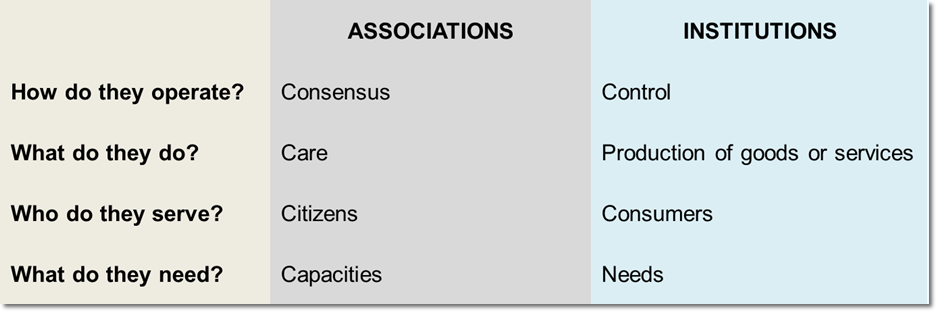
associations vs institutions
This comparison makes no judgment as to the relative value of either group. The table is simply meant to illustrate the distinct differences between the two types of organizations. Both types of groups are crucial to a democratic society and both must have the noted characteristics in order to work effectively.

It is in these non-elected, non-paid groups who come together for a common purpose where one will find social assets like caring, mutual trust, reciprocity and collective identity. Associations are not always easily identifiable, but they are all around us. Sometimes they have an obvious identity like a book club or quilting group. Other times they are just a group of people who have coffee at the same café three times a week. These groups represent the un-mobilized workforce of community change. They are simply waiting for someone to ask them to act on what they care about.

Four Strategies for Finding and Working with Associations

Mobilizing associations is critically important in ABCD.  How might we work with, and support the work of these groups of community members? Here are four places to start.

1.  Increase the number of personal relationships in the community.

Whatever your other goals might be, it is always useful to include increasing the number of personal relationships in the community. When people realize that there are others who care deeply about the same things that they do, they start looking for more out there who share their concerns. Pretty soon the talk becomes talk about doing something. Suddenly, a group of concerned residents organize themselves and begin to advocate for change. These associations are at the heart of our democracy.

2. Be deliberate about mapping associational assets.

If you are already committed to addressing a particular issue and your project meetings are only attended by people whose jobs brought them there, then you may not be recognizing the assets of associations. Early on in your planning process, identify community stakeholders and try to identify even a few formal and informal associations to lock arms with in your efforts to improve the community.

Even if these associations don’t immediately seem like they would share your project goals, try anyway. Think of the adopt-a-highway programs all around the country. Most of the student councils, local businesses, and book clubs that volunteer to pick up roadside trash don’t have mission statements about littering or environmental stewardship (if they have mission statements at all). The people in these groups do, however, enjoy the time they spend with people with similar interests; and they enjoy doing things that improve the community’s quality of life—or at least appreciate the public recognition they get on roadside signs. Mapping assets can help find a campus-community partnership version of the adopt-a-highway program.

3. Allow institutions and associations to do the things that they do best.

It is necessary for institutions to produce goods or services under fairly strict controls. When you are on the operating table, you would probably not be comfortable with the surgeon looking for a general consensus by asking: “Where does everybody think I should cut now?” When that surgeon participates in her neighborhood book club, however, nobody expects her to take control by instituting rigid protocols and standards for everyone’s participation.

In 2001, the George W. Bush administration created the White House Office of Faith-Based and Community Initiatives. After the first round of grants to faith-based organizations revealed that local church groups weren’t necessarily very skilled at federal grant compliance, a subsequent request for proposals included an organizational development component—in other words, it aimed to turn them into institutions. Institutions tend to be good at things like accounting, assessment, and evaluation. Associations are good at things like organizing, caring, compassion, and trust.

Institutions can support associational work by supporting local organizers. They might, for example, serve as the fiscal agent for grants that support the work of people who are passionate about developing their community, but who don’t happen to work for a nonprofit or government entity eligible to receive certain types of grant funding. They might increase the amount of purchasing they do from small, locally-owned businesses. They might make more of their community-based research, community-based participatory research. Imagine ways to complement the work of associations, without taking it over.

4. Provide opportunities for residents’ voices to be heard.

There are countless ways to find a community’s associations. There are the usual lists that folks at a Chamber of Commerce or a Welcome Wagon might have, but there are also types of civic engagement that can help unearth the often invisible groups in a community. Citizen journalism, oral history, and community arts projects are just a few of the ways to listen to residents, and to have them lead you to associations you may not know about. Many community associations may be active in online spaces. Do not dismiss the value of the assets of those who chose virtual platforms to express their values and creativity.

You may find that what started out as a search for community connections might also identify specific strategies to implement any eventual projects. People who face daily challenges have unique insights into how those challenges might be overcome. Many associations came into being for the sole purpose of mutual benefit.

Read the first section on Asset-Focused Leadership here.

Asset-Focused Leadership

“Every single person has capabilities, abilities and gifts. Living a good life depends on whether those capabilities can be used, abilities expressed and gifts given. If they are, the person will be valued, feel powerful and well-connected to the people around them. And the community around the person will be more powerful because of the contribution the person is making.”
– John P. Kretzmann and John L. McKnight

If you are interested in developing many of the other concepts we’ve been looking at, such as collaborative leadership, supporting more effective networks of concerned people, and helping them find their power; then Asset-Based Community Development (ABCD) is the organizing strategy for you. I have dedicated a good chunk of my life to helping folks discover community-building assets. I have done countless ABCD workshops, and have written about it on occasion. ABCD principles contribute many useful ideas to a re-imagined concept of leadership; therefore, I’ll dedicate multiple sections to it.

Don’t be scared off by the phrase “community development.” Community can refer to small groups of people who are passionate about the same issue, neighborhoods, or communities of interest – including those made up of people not sharing a community of place. For our purposes, development simply means to make better. Let’s start with the fundamentals.

ABCD, is an approach described by John McKnight and John Kretzmann, in the 1993 book, Building Communities from the Inside Out. It is founded on the belief that communities and neighborhoods thrive when built upon the knowledge, interests, and capacities of their residents, groups, and institutions.  This contrasts with the typical “needs-based” approach where the starting point is based on an assessment of deficiencies.

ABCD is not a formula. Rather, it is an approach to creating positive change that has many paths, but which necessarily includes three elements. One of the roles of leaders in asset-based endeavors to be a persistent compass when it comes to these three filters.

  1. ABCD is, by definition, asset-based. It starts with what already exists in the community. ABCD requires the community to inventory the skills and talents of individuals, the assets of formal and informal associations (including relationships) and those of local institutions.
  2. ABCD is internally-focused. The community frames the issues and challenges, and designs possible plans of action. This internal focus is intended simply to stress the primacy of local definition, investment, creativity, hope and control.
  3. ABCD is relationship-driven. To be successful, communities must be deliberate about constantly building and rebuilding relationships among residents, local associations and local institutions. Relationships create the underpinnings on which trust is built. Sharing common values and goals is one thing, but when you add trust to the mix, you have the beginnings of a recipe for power.

asset vs needOne way for leaders to assess their efforts as they begin is to ask themselves these questions:

  • Who decides what will be done? – Is this the vision of a small group of individuals, or is there a shared vision across a larger group of stakeholders?
  • Who are the producers of results? – Are “interventions” being done to, or for people; or are people accomplishing things on their own behalf?
  • How will the gifts of individuals & the community be identified and mobilized? – What approaches to asset mapping and strategic planning make the most sense?
  • Whose capacity is being built? – Are you simply replacing one rigid top-down system for another?

 Mapping Assets

Simply put, asset-mapping is systematically finding out what skills, talents, knowledge, relationships, and other assets currently exist in the community. This should include unearthing the capacities of:

  • Individuals – Talk to as many people as possible. Don’t forget marginalized people, those whose presence is not frequently (if ever) recognized.
  • Associations – These are social assets. They are not always easily recognized. They are identified by the fact that people are associating with each other without getting paid. The people in associations are together because they share a common passion or interest. Associations can be formal (a church congregation), or informal (a group of friends who meet every Tuesday for coffee at the same café).
  • Institutions – All public, private, and nonprofit organizations including schools, government, and businesses.
  • Physical Assets – This includes things like public space, buildings, and natural assets.
  • Exchange – Financial transactions, including things like deliberate local purchasing or boycotting.

Don’t panic. You don’t have to map the assets of the entire community. This isn’t an exercise in database creation. This is about looking for opportunity. These opportunities reveal themselves during the process of finding out how newly discovered assets can be connected and leveraged to increase relationships and moving people to act.

Once you know what change your community seeks to make start mapping with folks who might already be working to create that change?  No special training is necessary, though there are many people who can help you get started.

Your early group of leaders will have to define your community, figure out who is available to do the work on the ground, and assess your initial resources to do the mapping. You can use any number of methods, either via surveys, or better yet through one to one conversations, or appreciative inquiry. Remember, lists of information are good, but stories are even better because they can reveal hidden social and cultural assets.

Useful Resources

More on ABCD to come

Finding Opportunities in Conflict

“What people often mean by getting rid of conflict is getting rid of diversity, and it is of utmost importance that these should not be considered the same. We may wish to abolish conflict, but we cannot get rid of diversity…Fear of difference is fear of life itself.”
– Mary Parker Follett

We experience conflict every day. Every time you make a decision you are to some degree, resolving conflict. For people organizing to create change, conflict sometimes needs to be resolved between allies, and of course, always needs to be addressed with adversaries.

Rather than survey the mountain of literature available on the topic of conflict resolution, let’s focus for now on two things. First, we’ll explore Kenneth Thomas and Ralph Kilmann’s, Five Modes for Handling Conflict, and think about how they might relate to leadership. Secondly, we’ll address the notion that conflict – this thing that we’d all just like to go away, actually has numerous benefits that can help to develop other areas of our capacity to lead.

Five Modes for Handling Conflict (Thomas-Kilmann)

conflict resolution
Chart source: An Overview of the Thomas-Kilmann Conflict Mode Instrument, http://www.kilmanndiagnostics.com/overview-thomas-kilmann-conflict-mode-instrument-tki

According to Thomas and Kilmann, our behavior in conflict situations focuses on two dimensions: 1) assertiveness (What’s in it for me and how do I get it?); and 2) cooperativeness (How can I satisfy others’ concerns?). Leadership means having to constantly balance these dimensions in order to move closer to your desired outcomes.

Competing – Everyone uses all five of these modes of conflict resolution. More often than not, however, competing gets the most attention. When you are trying to make specific changes in the world, a zero-sum orientation is often where you find yourself. A referendum passes or fails. A candidate wins or loses. The key for leaders is not to let this single-mindedness spill over into every interaction, because the next success might depend on collaboration with one of your winner-take-all victims.

Avoiding – dodging conflict for the sake of appearing neutral can have a similar outcome to any aversion to risk – no pain, no gain. Removing yourself from a situation could mean not benefitting from the gains resulting from the successful resolution of the conflict. Leaders should to at least some degree, embrace conflict rather than avoid it.

Accommodating – allowing an unchallenged “win” in an effort to not rock the boat is a situational judgment call. What is the return on the investment of this good will? One warning, accommodation is also where a lot of ethically questionable behavior resides – like spinning something to make yourself look good, and the other party feel good,( “let’s let them think that they’ve won this, meanwhile we’re sticking it to them over here”).

Compromising – This is what used to happen in politics. People agreed to something that was tolerable to all parties, and maintained some sort of reasonable working relationship. Granted, compromise usually ends up in only baby steps forward, but small steps ahead are better and no progress at all, or backwards movement.

Collaborating – This is the elusive “win-win” situation. The value in collaborating lies in capitalizing on diversity – diversity of ideas, of approach, of notions of success.

Conflict Can Have Benefits

Try to look at conflict beyond simply being something that you want to go away quickly. You might see that it has some benefits. Here are some of them:

  • Conflict checks our complacency and self-satisfaction simply by making us aware that problems exist.
  • Conflict reveals diverse perspectives, getting beyond an either/or worldview, challenging our assumptions and leading to more comprehensive solutions.
  • Conflict resolution requires you to tap into your creativity. You learn about yourself, and about others, leading to greater emotional intelligence.
  • The process of resolving conflict often opens up new communication avenues and processes. In fact, lack of communication is often the source of conflict.
  • Successful conflict resolution can build trust. When people feel heard, and when their opinions are recognized and validated, the fair treatment they received makes them more likely to come forward in the future, before conflicts have an opportunity to fester.

Emotional Intelligence

“The best and most beautiful things in the world cannot be seen or even touched. They must be felt with the heart”
– Helen Keller

Acting with others in an effort to change something, or create something is inescapably emotional. This is a good thing. Emotional connection motivates people. It feeds their passion for achieving a vision of something better. It isn’t our job as leaders to tell people how they should feel. Everyone’s unique life experience, relationships, and knowledge inform their emotional state. Navigating something this complex requires that we develop some degree of emotional intelligence.

“Emotional intelligence is the ability to monitor one’s own and other people’s emotions, to discriminate between different emotions and label them appropriately, and to use emotional information to guide thinking and behavior.”
– Wikipedia, http://en.wikipedia.org/wiki/Emotional_intelligence

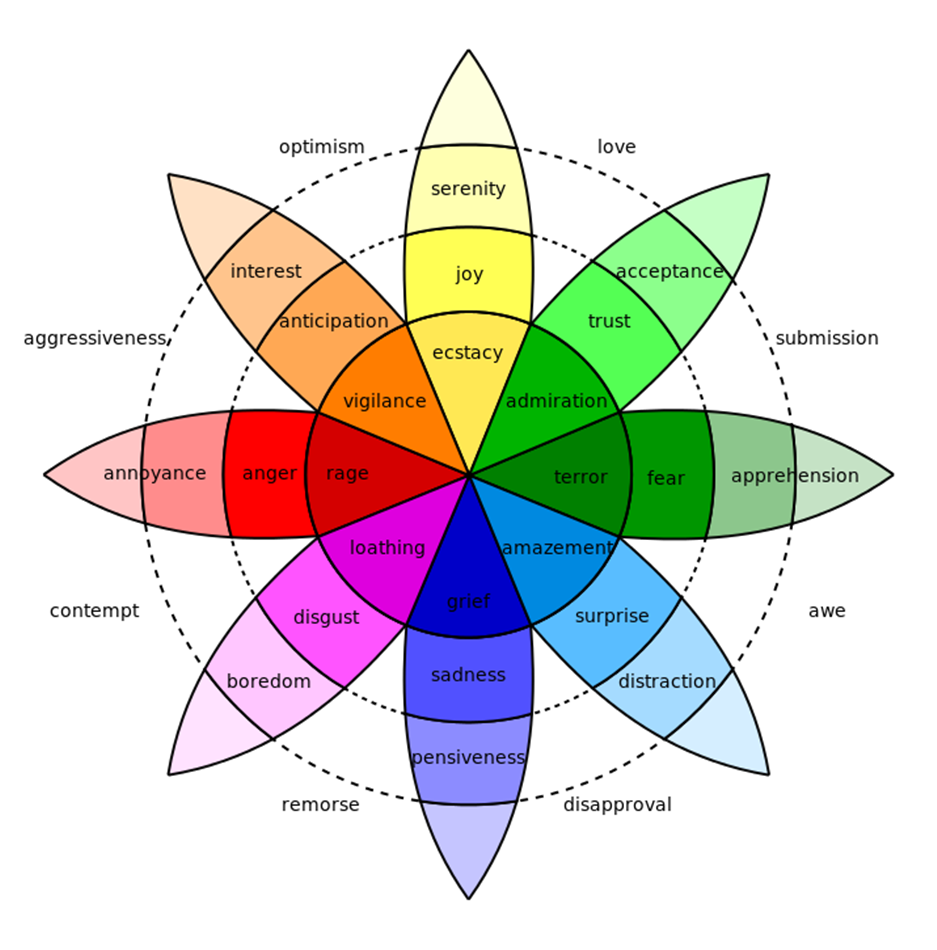
The chart below is quite different from other tables we’ve explored. It is Robert Plutchik’s Wheel of Emotions. The most intense emotions are in the inner circle. The next ring consists of Plutchik’s eight primary emotions—anger, fear, sadness, disgust, surprise, anticipation, trust, and joy. These are the emotions that he says trigger actions that we use to survive, such as the fight-or-flight response.

Plutchik's Wheel of EmotionsImage: public domain http://commons.wikimedia.org/wiki/File:Plutchik-wheel.svg

How is understanding this useful in leadership? Well, for example, if you look at the annoyance/anger/rage continuum, you probably know from experience that people are less likely to act on changing things that are simply annoying. It is also best if a problem has to get to the point of outrage before people act. Knowing when folks are angry enough to act to create change is important.

You don’t need an advanced degree in Psychology to develop emotional intelligence. There are some simple things you can do. The Internet is full of free help on this front, so I won’t go too in depth here. The most important things that you can do fall into two general categories: 1) becoming more self-aware; and 2) increasing your empathy.

Self-awareness requires articulating what you believe, why you believe it, as well as what you are thinking, and feeling. I’m not talking about being in a constant state of navel-gazing. It’s more a matter of taking a second during that time when you are thinking before you speak (You do that, right?), and asking yourself if you understand why you are saying what you are saying.

There are many other things that will improve your self-awareness. Daily writing is an easy one. It can be public or private, and doesn’t need to be lengthy. Try tweeting thoughts that are important to you, not just ones that you hope will be perceived as clever or funny.

If daily writing seems too burdensome, try writing a brief bio of yourself that contains no information from your resume. If you are looking for a less direct window into yourself to begin with, write about someone you admire, and explain why you admire them. It will tell you something about your own values.

Ask good friends, and family members how they perceive your character, attitude, and the general impression that you give . If they tell you things that surprise you, then you can take that opportunity to both further develop assets that they see in you, as well as work on negative aspects of their perception of you that they identified.

The most important path to developing empathy is to listen to people, REALLY listen to them. Believe what they tell you about how they are feeling. Don’t necessarily live by the so-called golden rule – ‘do unto others as you would have them do unto you.’ Consider this instead: “do unto others as others would have done unto themselves.”

As a leader, social responsibility is perhaps the greatest manifestation of emotional intelligence. It recognizes our interconnectedness, and our realization that, as Paul Wellstone put it, “we all do better when we all do better.”

Excellence Versus Perfection

“Ring the bells that still can ring
Forget your perfect offering.
There is a crack in everything,
That’s how the light gets in.
– Leonard Cohen, Anthem

excellence vs perfectionTable based on a poster from http://thebluecollarsuccessgroup.com/

There is not a great deal of conflict or controversy around this comparison as it relates to leadership. Perfection exists as a concept, but not as a practical reality. Good leaders encourage people to strive for excellence, not perfection. If you always wait for perfection nothing will ever get done. As psychologist and author Harriet Braiker put it, “Striving for excellence motivates you; striving for perfection is demoralizing.”

In terms of leadership, both of excellence and perfection find themselves under scrutiny in the context of achieving success. Success is usually measured by comparison to others. Our most visible manifestations of leadership are in campaigns — contests for the public’s hearts, or their imagination.

If in these challenges our competition is excellent, then we have to be more excellent — we need to be perfect, right? No.

In his 1989 book, The Heart of the Order, sports columnist  Thomas Boswell describes the difference between success and excellence this way:

“Success is tricky, perishable, and often outside our control; the pursuit of success makes a poor cornerstone, especially for a whole personality. Excellence is dependable, lasting and largely an issue within our own control; pursuit of excellence, in and of itself, is the best of foundations.”

If success is perishable, and perfection is unrealistic, then leaders in this “pursuit of excellence” are really part of an ongoing learning community, a network of people absorbing and acting on their shared knowledge and wisdom.

If we can agree that excellence is preferable over perfection, how can we make sure that excellence has substance? Look at the mission statements of nonprofit organizations, schools, and businesses. Apparently everybody is already excellent, because the claims of excellence are everywhere.

Maybe excellence is more of a constant reminder of betterment, of constant improvement, more than it is a state of being. Maybe the best way to achieve excellence is to maintain a modest intellectual curiosity, and an attitude that we want to learn something new every day of our lives.

Leaders Versus Managers

“You don’t manage people; you manage things. You lead people.”
-Admiral Grace Hopper

leader v mgrAdapted from a table at changingminds.org

This comparison is similar to the Entrepreneurs Versus Administrators relationship. One big difference is that entrepreneurship is usually associated with business or enterprise development. Of course, at the core of all of our explorations here is the idea of getting things done. Things do get done in organizations with rigid vertical organizational charts. Things also get done when passionate leaders build relationships and leverage diverse skills and
common values. A comparison of leaders and managers on the website diffen.com asks some questions that get to the heart of choosing an approach:

  • Does a manager have to be a great leader?
  • Does a leader need to have good management skills?

My response to both questions is, “not necessarily, but a little bit couldn’t hurt.” This is really a case of something not being questions of either/or, but rather times when both/and makes much more sense.

It’s like Grace Hooper said in the quote at the top of the page, people need leadership, but there are always details related to their work that require management. Even though these discussions center around leadership, business management guru Tom Peters is right when he said: “Stop being conned by the old mantra that says, ‘Leaders are cool, managers are dweebs.’ Instead, follow the Peters Principle: Leaders are cool. Managers are cool too!”

With this in mind, it seems critical for leaders to identify what aspects of the work that they are involved in require commitment to detailed control, and what aspects lend themselves to serving as a guide to help others navigate new terrain.

Narrowing The Gap Between Our Ideal And Our Real Values

“The whole idea of knowing who you are and what you stand for is so simple, yet also so profound and sophisticated. It’s difficult to pull off, but without it there’s no chance to institutionalize the vision and make it long-term and lasting.”
-Bob Boylan

Positive change usually happens after people have: 1) examined and understood their values; 2) articulated a shared vision after identifying their common values; and 3) strategically leveraged their own strengths toward achieving their common goals.

One big barrier to change is the fact that most people don’t spend a great deal of time analyzing their values. Your values are your principles, your personal standards of behavior. They tell people what you believe is important in life; and they indicate to others what you have in common at the deepest human level.

Examining your values is important because they become clear over time. They are not static; they change as you grow personally, establish relationships, and life experience. As you consider your values, it becomes apparent that some feel more personal than others. These might be called realized, or real values. The ones that seem like they have less to do with you personally are ideal values. They are things like freedom, democracy, and fairness.  You know that you should value them, and you don’t spend much time thinking that other people might have wildly different understanding of what they mean.

Despite these differing interpretations, ideal values are considered absolute. They are written into law. Real values help to resolve the contradictions between ideal values and people’s everyday behavior.

The Gap, the Contradictions, and the Conflicts

“The shepherd drives the wolf from the sheep’s throat, for which the sheep thanks the shepherd as a liberator, while the wolf denounces him for the same act as the destroyer of liberty, especially as the sheep was a black one. Plainly the sheep and the wolf are not agreed upon a definition of the word liberty.”
-Abraham Lincoln

If you asked any 100 people in your community if any children in your town should be going to bed hungry, I would guess (and hope) that they would all express that having no undernourished children is a community value. If everyone shares that value, why are children going to bed without enough to eat? It probably isn’t a disagreement about the definition of hunger or malnutrition that is the barrier to coming up with the political will to do something to address the problem.

The gap between the ideal and real value isn’t simply the fault of individuals. Many people would act if they knew what actions they could take. This is where leadership comes in. Leaders can help individuals understand how their real values, things like justice, empathy, community, etc., can inform a strategy to solve the challenges of making sure that people have enough to eat.

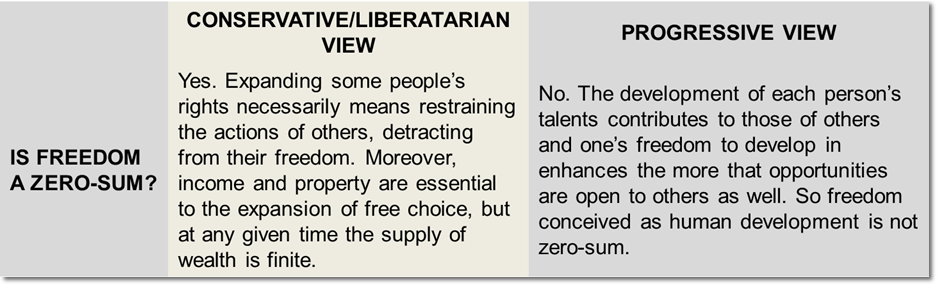
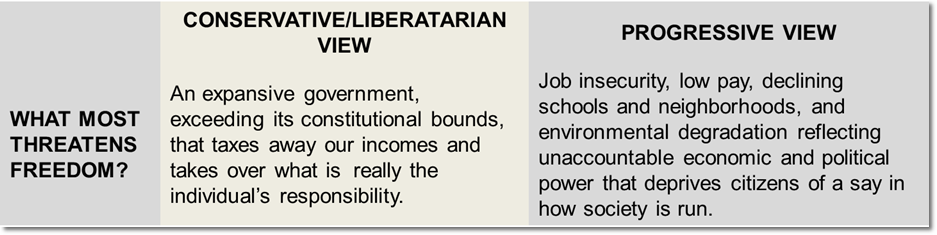
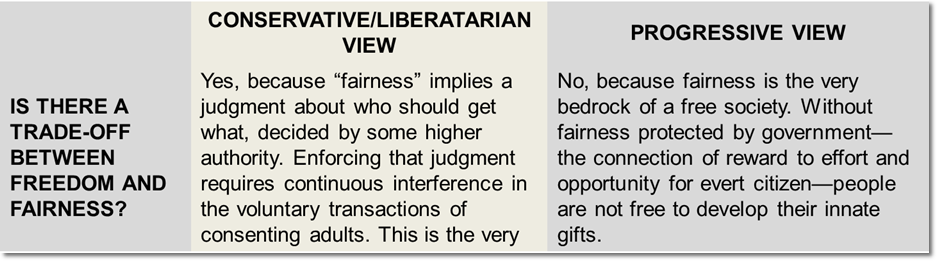
Democracy is a commonly expressed ideal value. If we all believe in democracy, why is voter turnout not 100%? Is it just the IDEA of the ideal value that is important, or are people willing to act on their common values? The table below begins to illustrate why narrowing the gap is not an easy task. It shows how people might have opposing ideas about something perceived as an ideal.

The tables below are based on Frances Moore Lappe’s insightful book, Rediscovering America’s Values. In the book, Lappe explores the nuances of some ideal American values. Here are just a few of the competing ideas she presents relating to freedom.

freedom1freedom2freedom3Despite differing views on these values, how do we work to find common ground? What steps can people take to help narrow the gap between ideal and real values? Dr. Greg Waddell suggests four things in particular:

  1. Reward what you value.
  2. Measure what you value.
  3. Model what you value.
  4. Design life experiences of what you value.

Think about these four actions as they relate to a personal value. How do you consciously live your values? More on values to come.

Traditional Versus Collaborative Leadership

“Collaboration isn’t about being best friends, or even necessarily liking everyone you’re working with. It is about putting all and any baggage aside, bringing your best self to the table, and focusing on the common goal.”
-Meghan M. Biro

The table below was developed from the extensive work found on the  Collaborative Leadership website of the Leadership Development National Excellence Collaborative.

traditional vs collaborative leadershipCollaborative leadership is all about the intentional development of relationships that enables individual successes by stakeholders while accomplishing a collective outcome. As you look at the comparisons in the table it is clear that most of the world seems to reside in the rigid world of positional leadership described in the left column. There is, however, a lot more collaborative leadership going on out there (or at least headed in that direction) than you might think.

Living in the digital age makes collaborative leadership easier to accomplish, because the open sharing of information is at the heart of making it work. Micro meetings, quick polling, crowdsourcing, and other realities of a life immersed in portable, digital information make once idealistic ideas like self-governance, and broad participation possible.

Another key difference between traditional and collaborative leadership is that the latter is at its core, rooted in trust. When stakeholders voices are not only heard, but in fact, embraced for their valuable perspective; trust is cultivated, and shared time and effort result in productivity.

More to come, as this concept is closely tied to a number of the others discussed here.

Working Together: Coordinating, Cooperating, Or Collaborating

“I never did anything alone. Whatever was accomplished in this country was accomplished collectively.”
—Golda Meir

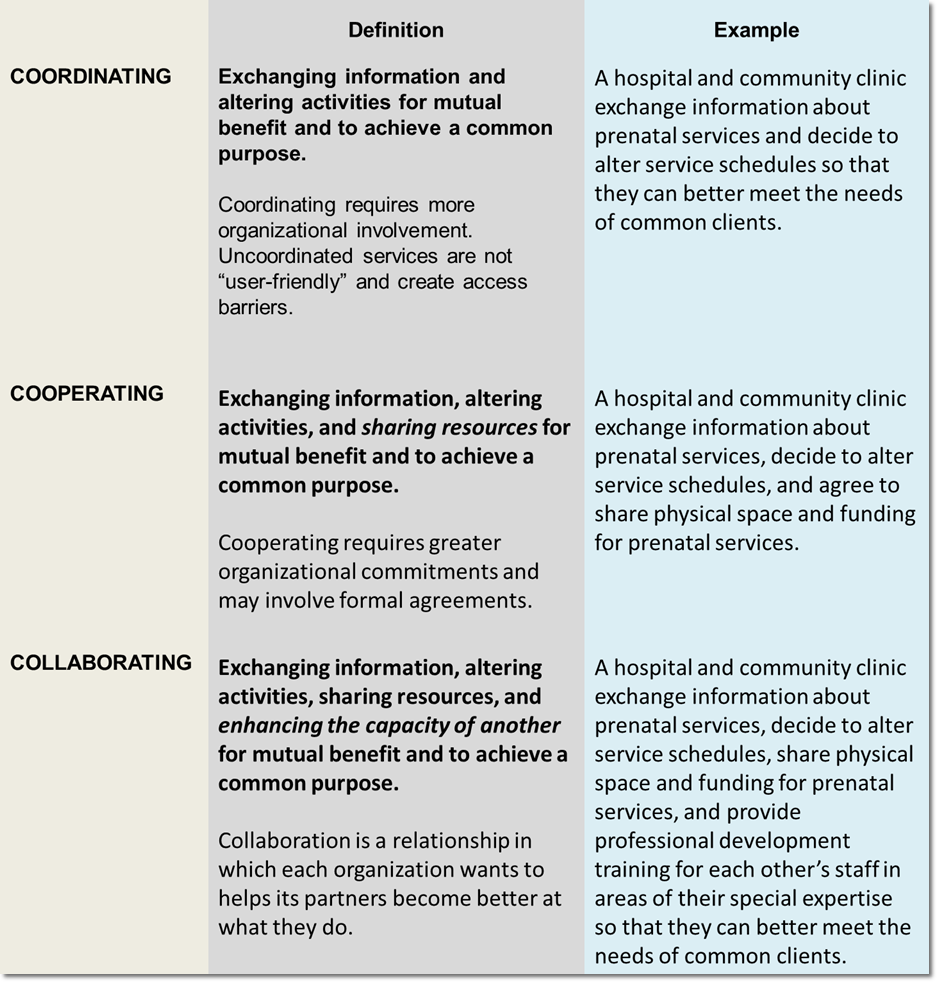
Source for the table below: COLLABORATION FOR A CHANGE (revised January 2002)
Definitions, Decision-making models, Roles, and Collaboration Process Guide
By Arthur T. Himmelman

CCC_HimmelmanWhen people talk about working together the subtext for everyone at the table, whether it is said aloud or not is usually: “what’s in it for me, and what’s it gonna cost?” Arthur Himmelman’s distinctions between these three concepts are important in that they illustrate how as relationships grow and deepen, critical aspects of working together, like trust and confidence, pave the way for shared risk and resources.

Moving from coordinating, to cooperating, to collaborating isn’t a seamless, smooth evolution. People who work together successfully spend plenty of time up front not only “getting on the same page,” but also honestly sharing their expectations and commitments with their potential partners.

Another important thing to remember is that every partnership doesn’t have to be, or strive to be a collaboration. Sometimes simple coordination can achieve a goal. When that is the case, that success can serve as an underpinning for a deeper partnership.