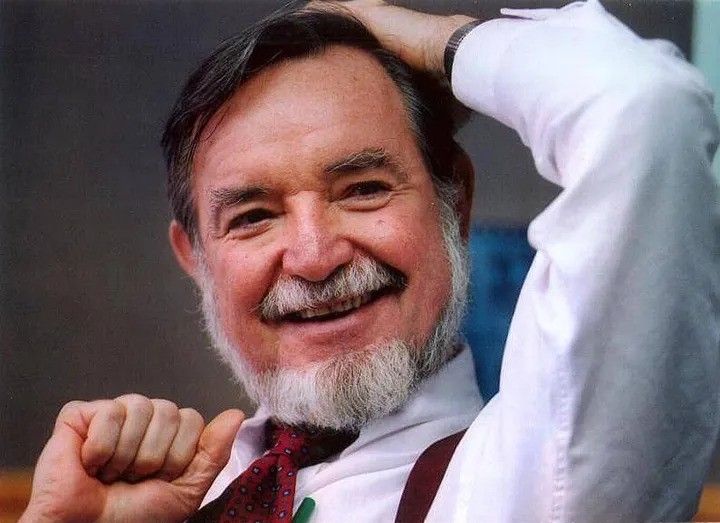
A lot of John McKnight’s influence can be found on these pages. I learned a great deal about community organizing, change, compassion, and humility from him. John passed away a week ago.
There is a well-known quote from Maya Angelou, “I’ve learned that people will forget what you said, people will forget what you did, but people will never forget how you made them feel.” When I think about the legacy of John McKnight, I do indeed remember what he said and did, but most of all I remember how he made me feel.
When you had a conversation with John, regardless of the topic, somehow you left the conversation feeling better about yourself. You felt validated in your pursuits. You had an increased sense of hope.
Whether in a one-on-one chat, or in an auditorium full of people, you felt like John was talking directly to you in the most wise, and profound way imaginable. I once invited him to deliver a keynote speech to a group of people who didn’t always work with a focus on peoples’ capacities. John gave a short talk that consisted mostly of stories of normally invisible people doing amazing things for their communities. The talk was great, but the Q&A afterward was even better. His answers humanized concepts with real stories, when questioners thought they were looking for theoretical answers.
John McKnight was a modest, unassuming man who changed the lives of thousands of people throughout the world. He encouraged them to work with others in their communities, especially the marginalized, to improve everyone’s quality of life. His legacy is profound.
I learned a great deal from him. I am saddened that he no longer walks the earth. I will, however, always remember how he made me feel.
John L. McKnight died peacefully at his home in Evanston, IL on November 2, 2024, at the age of 92.
Illustration from Edwin D. Babbitt’s The Principles of Light and Color, 1878, (public domain)
“… what you learn today, for no reason at all, will help you discover all the wonderful secrets of tomorrow.”
Norton Juster, The Phantom Tollbooth
After publishing my recent post, “Five Quotes About Listening,” I began to think more about the relationship between listening and curiosity. I started to think that curiosity might possibly be the most important leadership trait. It creates relationships and is a key to both social and emotional intelligence. It feeds innovation and informs shared vision (you have to be curious about what an alternative to the status quo might look like in order to make it happen). Without curiosity, we can get locked into inaction by a sense that the familiar is an absolute, immovable reality.
Without curiosity, mysteries and crimes would never be solved. Novels could not be written. Curiosity inspires learning, and discovery. Without it, there would be far fewer scientific discoveries. Scientists will tell you that the laboratory isn’t just a series of “eureka” events. More often than not scientists will look at some result in their lab and say, “hmm, that’s weird.” Curiosity is sparked. Discoveries are made.
Years ago, I was working on a writing project. I had been researching the life of a woman who had accomplished some amazing things as a teenager in the early 1930s. She had passed away, but one of the people I interviewed told me that the subject of my research had a younger sister who was still alive, and that she would be happy to introduce us. This was a tremendous opportunity.
I prepared a list of eight to ten questions to ask the younger sister. On the day of the interview, I got to the third question, and her answer introduced ideas I had not considered. My curiosity told me to go down the path the sister was taking me, rather than the path that would fill the gaps of the story I had thought would be important to tell. As a result of remaining curious about the direction the sister led me, my understanding of the story I wanted to tell became deeper, more nuanced, and compassionate.
Curiosity makes you dig deeper. It can bring additional clarity to positions you already hold. But it can also give you the courage to change your mind.
Curiosity is a prerequisite for creative leadership, and continuous learning. Being a leader doesn’t mean that you know everything. It means that you are always on the lookout for context, lucidity, and insight. Curiosity allows you to see the world through many different lenses. Be curious.
I just Googled the phrase “effective listening.” It produced 312 million results. 312 million! For generations, there have been throngs of people in this world trying to teach us how to be better listeners. It is amazing that we are still so terrible at it. I guess we just haven’t been listening. As writer M.M. Owen recently said in an essay published on the website Aeon titled, “The Art of Listening:”
“As a culture, we treat listening as an automatic process about which there is not a lot to say: in the same category as digestion, or blinking.”
It isn’t always easy to listen, especially when you are attempting to listen to people with whom you strongly disagree. When the first thing out of someone’s mouth pushes a button in your brain that demands to construct a rebuttal, you have probably stopped listening already. In his book, “Killosophy,” author, Criss Jami puts it this way:
“It’s not at all hard to understand a person; it’s only hard to listen without bias.”
Even when people spend most of their time in social media echo chambers where they develop narrow worldviews, draw lines in the sand, and refuse compromise, it is still important to know how those worldviews were constructed.
People’s views are often formed by personal experiences, as opposed to being rooted in deep ideological theories. Empathetic, active listening can help us hear and see the humanity in people who we have previously thought of in terms of labels such as evil, or the enemy.
People whose voices are not heard risk becoming invisible to society. When you are invisible your human rights are at risk. Sometimes, simply being heard and acknowledged can help bring marginalized people to the decision-making table and potentially deescalate tense situations. In the words of Hugo Powell,
“Listening, whether done by individuals or by companies and government, is a signal of respect. When people don’t feel listened to, they don’t feel respected. And when they don’t feel respected, they feel anger and resentment. This resentment is exacerbated if people think you’re pretending to listen but aren’t.”
It is frequently pointed out that listen is an anagram for silent. A lack of distractions, eye contact, and giving one’s full attention are important. It is also important, however, to break your silence to confirm that you understand what someone is telling you. People want to be both heard and understood.
In her novel, “The Lake,” Banana Yoshimoto, talks about listening as a responsibility.
“When someone tells you something big, it’s like you’re taking money from them, and there’s no way it will ever go back to being the way it was. You have to take responsibility for listening.”
Once you know something it is difficult to unknow it. What you do with information is a reflection of your values. If listening reveals that someone might be in danger, or is starving, moral and ethical questions are suddenly in the forefront. Listening is serious stuff.
I want to share one last quote about listening. It is from Eudora Welty’s book, One Writer’s Beginnings:
“Long before I wrote stories, I listened for stories. Listening for them is something more acute than listening to them. I suppose it’s an early form of participation in what goes on. Listening children know stories are there. When their elders sit and begin, children are just waiting and hoping for one to come out, like a mouse from its hole.”
Listening should not be considered a chore. When you listen, it should be done with a sense of anticipation that something important, or insightful might be about to come your way. Welty’s idea of “listening for” rather than simply “listening to” is a great reminder that at any moment you might hear some thought or idea that you did not expect to hear. That thought or idea might shed light that makes a little more sense of something that you’ve been struggling to understand. Listening always has the capacity to give unexpected gifts.
[Note: I originally published this piece on the ABCD in Action website.]
“There is one word which may serve as a rule of practice for all one’s life -reciprocity.”
Confucius
In the world of community-building there may be no concept more important than reciprocity. The acknowledgement of mutual dependence is at the core of a healthy society. Social psychologist, Jonathan Haidt calls it, “the basic currency of social life.”
I realize that anthropologists, and economists have their own definitions, so I want to be clear. I am not defining reciprocity simply as some sort of exchange marketplace. I’m talking about reciprocity as the recognition of the fundamental humanity and value of every member of the community, and the recognition of the interdependence of each community member.
Recognition of mutual benefit is important. You see it demonstrated all the time in thriving communities. People with no school-aged children will vote in favor of school referendums because they understand the value of educating youth. People shop at farmer’s markets, and locally-owned businesses because it sustains community economic development.
A sense of reciprocity is also expressed through volunteerism. According to The Corporation for National & Community Service, one out of four American’s volunteer, two out of three Americans help their neighbor (informal volunteering). These volunteers are almost twice as likely to donate to a charity. To be reciprocal is to look at the world around you through a community lens.
Reciprocity is:
The place where trust resides;
A key to belonging;
A contributor to one’s sense of place;
Generosity of spirit;
The enemy of selfishness; and
A condition that allows each person’s gifts, skills, and talents to be shared and celebrated.
Although I agree that it can come in useful on certain occasions, if you were hoping for tips on reconnaissance or spying, you are going to be disappointed. I apologize. I am using “intelligence” here in the context of acquiring skills, habits, and knowledge that help you better understand yourself, and other people.
We frequently think of intelligent people in terms of academic achievement. People with academic intelligence are logical, and seek evidence based on the analysis of data. They remember theories, and formulas. They got good grades in school.
There are, however, other types of intelligence. Some people say there are eight types, others nine. Some believe there are 12 types. I want to focus on three particular types of intelligence that are necessary in order to effect change. They are: emotional intelligence, social intelligence, and existential intelligence.
Emotional Intelligence
I like the definition of emotional intelligence on the helpguide.org website it says that “emotional intelligence is the ability to understand, use, and manage your own emotions in positive ways to relieve stress, communicate effectively, empathize with others, overcome challenges and defuse conflict.”
We are passionate about the things we want to change in the world. Passion and emotion go hand in hand. We feel the desire for change on a very personal level. The emotions of both our allies, and our rivals run deep. Emotions can lead to deeper ways of knowing. They can also inflame tensions.
Things you can do to develop your emotional intelligence include:
Hone your listening skills – Avoid preconceptions. Encourage the speaker to be open and honest. Understand the speaker’s point of view and ideas, even if you don’t agree with them.
Understand that all criticism is not an invitation to fight.
Try to empathize. Don’t avoid difficult conversations. Examine your own biases.
Be aware of the ways your emotions might be barriers to understanding complex situations. Take time to consider expressing clear, thoughtful responses rather than simply giving knee-jerk reactions.
Social Intelligence
Social intelligence is developed through experience. Unfortunately, we cannot anticipate every circumstance and event in life. We can’t fully cultivate social intelligence simply from educating ourselves. Sometimes our interpersonal interactions do not go well. Recognizing why those exchanges went poorly helps us learn from our mistakes.
Leading change requires diplomacy. Good diplomats have social intelligence. They show discretion and thoughtfulness in their interactions with other people. Tactful consideration for others builds trust, and trust is priceless.
Healthy personal relationships are at the core of every level of positive change. We do not walk the world alone. In the words of the late American radio personality Earl Nightingale, “Getting along well with other people is still the world’s most needed skill. With it…there is no limit to what person can do. We need people, we need the cooperation of others. There is very little we can do alone.”
Existential Intelligence
Existential intelligence is all about bringing out the philosopher in you. It involves thinking deeply about the big picture. Pondering existential questions is often related to the desire to create social change. For example:
Are there values that we all share?
Are there universal human rights?
What is your purpose in life?
Thinking about life’s big questions can lead to people evaluating their values, and making changes in their lives in an effort to take responsibility for their actions based on those values. People leave “successful” careers to work at making the world a better place. (See the post, “Narrowing the Gap Between Our Ideal and Our Real Values”). You may not spend countless hours contemplating existential questions, but whatever time you do spend will always be time well spent.
Note: I realize that more than half of my readers are not U.S.-based, so I apologize in advance for what is probably a very American-centric bit of writing. If there are similarly frustrating phrases where you live, feel free to comment below.
There are certain phrases that make me cringe. My negative reaction to these frequently repeated expressions is rooted in the ways that they can be obstacles to creating change in the world. Here are four of my least favorite phrases.
“It is what it is.”
Being told to “deal with” a frustrating situation because there is nothing you can do to change it, sounds like an instruction to give up. If a condition is unacceptable, there is nothing the people who benefit from the status quo like to hear more than, “all we can do is accept it and get over it.” When you hear, “it is what it is,” the best response is to come up with strategies to create change despite the situation, not give up because of it.
“No offense, but . . .”
Obviously, when you hear this phrase, you are about to be offended. The reason a person will use this phrase when talking to you is that they think that you need to know that they believe that they are smarter than you are. They don’t, however, simply use this thinly veiled passive-aggressiveness to challenge facts. In my experience, “No offense, but,” is frequently the introduction to any number of logical fallacies. It’s a power play often followed by nonsense. Know your stuff. Hold your ground.
“Everything happens for a reason.”
I understand that many people find comfort in the thought that a supreme being’s providence makes a horrible reality perhaps a bit more tolerable. Other folks like to explain things based on the alignment of the stars and planets. I’m not here to ask you to abandon your belief system.
There are times, however, when changes in human designed policies and practices are at the core of some terrible things in the world. Yes, everything does happen for a reason, and if we take the time to analyze the situation, we can figure out what those reasons are. And if those reasons can be addressed by correcting flawed human constructs, shouldn’t we do what we can to make those changes?
“In these trying/uncertain times.”
I do not disagree that a global pandemic has created disruption and uncertainty in people’s lives. I also know that for poor and marginalized people, life has always been trying and uncertain. I am not interested in simply getting the world back to a pre-COVID state. I want the world to be better than that.
The pandemic has given lip service to “all of us being in this together.” But in reality, this extraordinary event has reinforced the harsh realities of inequality. Poor people got poorer healthcare. People were deemed “essential workers,” yet were often not paid enough to meet their basic needs. As we move toward returning to “normal,” we need to remember to continue to work on reducing the uncertainty in everyone’s lives.
“Some men have thousands of reasons why they cannot do what they want to, when all they need is one reason why they can.”
– Martha Graham
There are hundreds of reasons to take an active role in creating a better world. Here are just five of them.
You find yourself complaining a lot.
You find yourself starting too many sentences with phrases such as, “Why doesn’t somebody” or, “When are they going to.” You are that somebody.
Children depend on you.
Everyone can think of an issue where children are adversely affected through no fault of their own. The world needs to be safe for future generations.
You’re smart.
You know more about the issues that you’re passionate about than most people do. You’ve already got a head start on creating a solution.
Nobody should have to live in fear.
Whether it’s fear of the unknown, fear of failing, or fear of what other people think, fear limits our choices, our options, and our opportunities. You have more courage than you know.
You need to eat, drink, and breathe in order to live.
Despite differences in political ideology, everyone has some fundamental common ground when it comes to life’s necessities. Consider starting with issues that touch these commonalities, and find some unlikely allies.
Like I said, there are hundreds more reasons. Those reasons are connected directly to your most closely held values. You care. How can you not act?
Kent Brockman: Mr. Simpson, how do you respond to the charge that petty vandalism such as graffiti is down 80%, while heavy sack beatings are up a shocking 900%?
Homer: Oh people can come up with statistics to prove anything Kent. Forty percent of all people know that.
– The Simpsons, “Homer the Vigilante”
We live in a world where civil discourse has become a rare commodity. There is little productive debate on topics of great importance, because people of influence and affluence have decided to force every issue into a framework consisting of lines drawn in the sand. This presents a tremendous challenge not only to democracy, but also to anyone advocating for social change.
I am not a scholar of the art of rhetoric. Nor do I claim to understand how argument and debate manifest themselves in cultures other than the one in which I live. With that in mind, here are a few thoughts on how you might, or might not want to approach arguing.
Arguing as Seed Planting
There are different definitions of “winning” an argument. An argument does not have to be a knock-down-drag-out fight. Sometimes the win simply consists of giving the other person something to think about.
Unless it is a unique situation involving instant replay enabling rules, when a coach or manager in any sport argues with a referee, they do not usually expect that a call will be immediately overturned. They are, however, planting seeds of concern or doubt in the mind of the official. If I tell you that number 12 is routinely breaking a rule, you will probably pay more attention to number 12 as the game moves forward.
Don’t Argue Values
The issues that we disagree on are laden with personal values. People have opposing views on issues because they have conflicting values. I dislike chocolate ice cream. I love vanilla ice cream. You will never convince me that chocolate ice cream is preferable to vanilla ice cream. When you argue that chocolate is better than vanilla, what is in dispute is a value. It is a preference, not a fact.
We should not fall into a trap of engaging those with whom we disagree in arguments about values. If you argue, it should be about facts. Facts still matter, and your facts should always be accompanied by evidence. In fact, next time you feel yourself being pulled into an argument, try the following approach. Don’t immediately set out trying to change the other person’s mind. Don’t tell them that they are wrong. Instead, articulate as clearly as succinctly as possible, the reasoning that supports your position. When you meet a skeptical person explain to them why you have taken your stand.
Don’t Argue – at Least Not with Everyone
There is a psychological concept known as cognitive dissonance. It suggests that people have a hard time dealing with the stress created by simultaneously holding contradictory beliefs, ideas, or values. It is believed that in order to reduce the discomfort created by the conflicting ideas, people will avoid the introduction of the conflicting ideas whenever possible. There are multiple research studies that suggest that people often see attacks on their belief as attacks on their identity, thus making them dig in their heels even more, thus increasing divisiveness.
If you refer back to my piece, “Change Happens at the Center,” you will see a strategy that may be useful when you’ve identified where a person sits on the continuum of opinion of the issue in question. The idea is to avoid the line in the sand people by focusing on moving passive opposition to a neutral state; neutral people to a passively supporting state; and passively supportive people to a fully committed state. Read that full post here.
Agree with Your Opponent
Using a type of paradoxical thinking, you might use an approach that doesn’t directly argue with a person, but rather, tells them that they are right. Then, using their assumptions, you come up with absurd examples that prove their point. Fair warning, this technique can backfire so be sure to practice it in some friendly, inconsequential settings first.
Go Ahead and Argue
Finally, if you absolutely have to throw down the gauntlet, try to go in with some sort of strategic framework. Here is an example of some tips which you might want to use to engage with your adversary. They come from, “10 Tips On Going For An Argument Win” by Siobhan Harmer (See the full article for details).
Start off pleasantly
Base your arguments on facts
Respect the opinions of the other side
It does not hurt to admit your mistakes
Exercise self-control
Try to have your adversary agree with you
Ignore statements that have no merit
Always keep an open mind during arguments
Give your adversary the time to talk
Play Up Your Arguments
That’s all I’m going to say on the subject for now, so don’t argue (or do . . . it’s up to you).
We are frequently challenged by issues that divide our time, resources, and energy between short-term maintenance of symptoms, and strategic organizing around a real solutions to deeper social problems. For example, soup kitchens and food shelves do not solve the problem of persistent malnutrition. They are critically important, and potentially life-saving maintenance strategies, but they do not begin to get to the core of the issue of poverty.
The temporary solution, and the permanent solution have a complex relationship. The temporary fix frequently has a charity approach. The implementation of this approach often occurs without an eye to broader social change. For instance, if you are motivated by the Bible, and Matthew 26:11 says ‘The poor you will always have with you,’ then you may simply feel that it is your Christian duty to be charitable to a permanent class of needy poor people. Further complicating matters is the fact that the short-term charity is a quick exchange that makes the benefactors feel good about themselves. The complex unraveling of causes and options that could lead to a more permanent solution, just seems like hard work – because it is.
The permanent solution requires a commitment to the belief that the so-called “needy” have paths out of poverty. Identifying and navigating those paths requires political will, and investment in low income people’s abilities to be productive, gainfully employed residents of the community.
So what does all of this have to do with leadership? Let’s return to the example of hunger.
Who is actively working on the issue of hunger in your community? Was your immediate response organizations that are involved solely in hunger relief? Probably. People need to eat every day. Hunger, as a phenomenon, is a daily concern. Hunger, as a social issue, however, requires a simultaneous focus on increasing the wealth of individuals and families who have less money than other people in our communities.
Leaders engage in strategic planning. They need to know who is already participating in related work, and whose intellectual, relational, natural, and financial assets have yet to be leveraged to achieve their common goal.
Malnutrition, hunger, and related concerns are all most effectively addressed when we see them as community development, workforce development, and economic development issues. It’s simple, people with more money overall, have more money to spend on food. So by all means, feed people. Treat them with dignity, and recognize their humanity. Your efforts, however, must also be complemented by plans to increase the wealth of those same people as part of a sustainable solution to the challenges to seek to overcome.
“When I dare to be powerful – to use my strength in the service of my vision, then it becomes less and less important whether I am afraid.” –Audre Lorde
There seems to be a frightening lack of vision in the world. People want things to be different, but they are unable, or more likely, unwilling to imagine what that different world looks like. Or maybe, they have a good understanding of their own values, and have developed a personal vision, and are simply not sharing it with other like-minded people. Nothing will ever change without a shared vision of how things could be.
The image above is an important concept for leaders to understand and appreciate. If you look at the number of arrows in each of the three sections, you will notice that they decrease as you move from “no vision” to “shared vision.” Movements and campaigns do not start out on a large scale. A shared vision is the result of people in small groups sharing their values with others. It is through the understanding of their common values that people begin to create a shared vision.
Your vision should be:
reflective of shared values;
explained in the least complex way possible;
realistically achievable;
and it should motivate people to act, moving them to look beyond their limitations.
A vision isn’t just a dream. It’s a dream and a plan. When stakeholders share similar values, they can begin to develop a shared vision by asking these three questions:
What is?
What could be?
What events could affect that change?
Simply put, shared values lead to a shared vision, which leads to shared ownership of creating change, and ultimately shared benefits for all stakeholders.
“The most important thing to remember is this: to be ready at any moment to give up what you are for what you might become.” – W. E. B. Du Bois
When your goal is to create change in the world, embracing risk is the foundation of leadership. Attempting to mitigate all risk out of an action eliminates any possibility that that action will result in substantive change.
Risk-averse people naively expect that success will simply to come to them. Risk-takers understand that success requires creative, strategic pursuit. Your goal is to get people to act, and wholeheartedly embracing risk is the only prescription for overcoming complacency, apprehension, and fear of failure.
Risk ≠ Recklessness. The desire for change is not just emotional; it is also rooted in logic. Risk is calculated. It is a carefully considered series of if/then statements that reach a conclusion that risk has a return on investment. Without risk, the logic model remains theoretical. Risk demonstrates people’s capacity to achieve a stronger, more vibrant society.
Risk is not just about avoiding the negative. It is important to fall into the trap of thinking about risk the way that insurance companies do. If you only define risk in terms of the chance of damage, injury, or financial ruin, you will always see advocating for change as too risky.
Seeing risk only in terms of generating fear can incapacitate you. In leading change, it is important to replace, “we can’t do that because,” with “we can do that despite.” Sure, not all risks pay off. We learn from those. Some risks, however, will pay off. The ones that succeed create hope. They lessen fear. They strengthen resolve. They give you confidence.
When you embrace a strategy that might be considered risky, it can catch those who oppose you off guard. Your risk can also get the attention of the undecided, as you present an alternative that reflects your shared values. Risk is not just about avoiding the negative.
Risk is at the Core of Leadership
Be United The idea of strength in numbers can make risk less scary. Leaders aren’t simply assessing risk on a personal level. They have locked arms with stakeholders sharing a common vision of what change needs to take place. Risks are shared as well.
Be Committed Willingness to risk is a measure of commitment to values and to a shared vision of the change that needs to happen.
Be Creative Willingness to risk is also a measure of creative thinking. If you can’t imagine a better future, it will never come about.
Be Radical Transformative change is radical change. Ending slavery was a radical idea. A woman voting was a radical idea. Don’t be concerned about being seen as radical. Be concerned about doing what is right.
Life is a continuous risk-taking process that goes something like this: risk, success or failure, learn, and repeat. You are working to change something. Change is impossible without risk, and change is required to better people’s lives.
“The best and most beautiful things in the world cannot be seen or even touched. They must be felt with the heart” – Helen Keller
Acting with others in an effort to change something, or create something is inescapably emotional. This is a good thing. Emotional connection motivates people. It feeds their passion for achieving a vision of something better. It isn’t our job as leaders to tell people how they should feel. Everyone’s unique life experience, relationships, and knowledge inform their emotional state. Navigating something this complex requires that we develop some degree of emotional intelligence.
“Emotional intelligence is the ability to monitor one’s own and other people’s emotions, to discriminate between different emotions and label them appropriately, and to use emotional information to guide thinking and behavior.” – Wikipedia, http://en.wikipedia.org/wiki/Emotional_intelligence
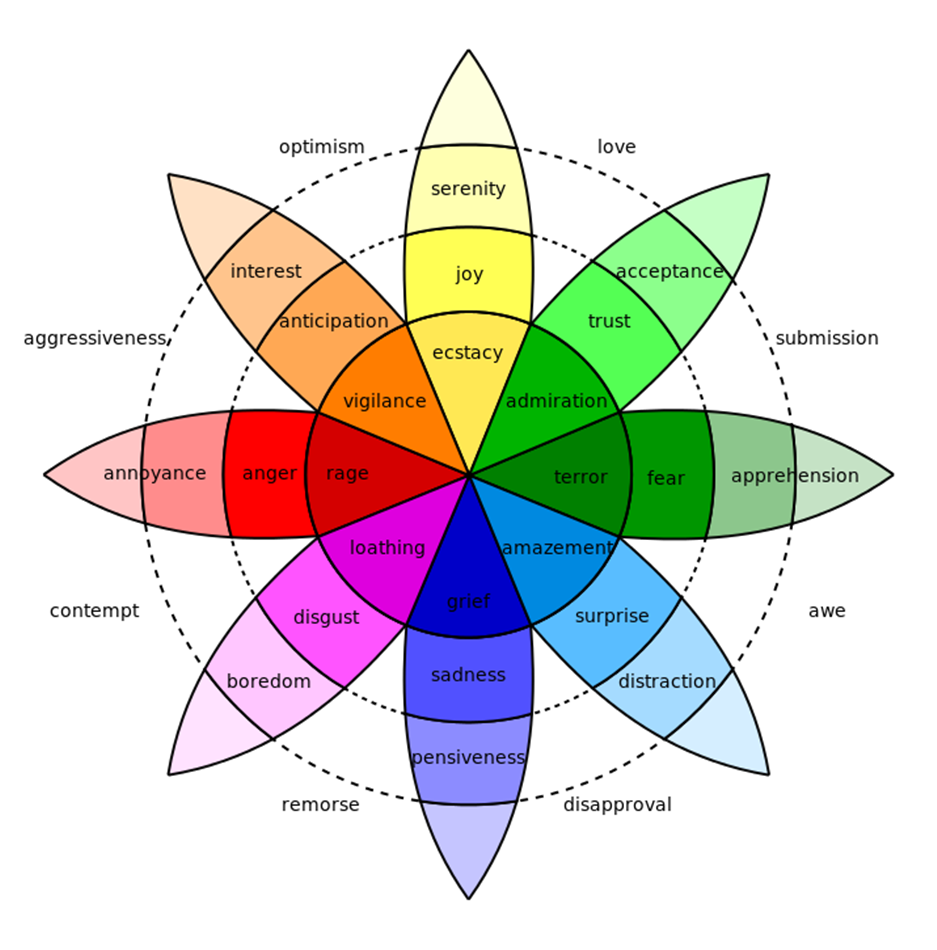
The chart below is quite different from other tables we’ve explored. It is Robert Plutchik’s Wheel of Emotions. The most intense emotions are in the inner circle. The next ring consists of Plutchik’s eight primary emotions—anger, fear, sadness, disgust, surprise, anticipation, trust, and joy. These are the emotions that he says trigger actions that we use to survive, such as the fight-or-flight response.
How is understanding this useful in leadership? Well, for example, if you look at the annoyance/anger/rage continuum, you probably know from experience that people are less likely to act on changing things that are simply annoying. It is also best if a problem has to get to the point of outrage before people act. Knowing when folks are angry enough to act to create change is important.
You don’t need an advanced degree in Psychology to develop emotional intelligence. There are some simple things you can do. The Internet is full of free help on this front, so I won’t go too in depth here. The most important things that you can do fall into two general categories: 1) becoming more self-aware; and 2) increasing your empathy.
Self-awareness requires articulating what you believe, why you believe it, as well as what you are thinking, and feeling. I’m not talking about being in a constant state of navel-gazing. It’s more a matter of taking a second during that time when you are thinking before you speak (You do that, right?), and asking yourself if you understand why you are saying what you are saying.
There are many other things that will improve your self-awareness. Daily writing is an easy one. It can be public or private, and doesn’t need to be lengthy. Try tweeting thoughts that are important to you, not just ones that you hope will be perceived as clever or funny.
If daily writing seems too burdensome, try writing a brief bio of yourself that contains no information from your resume. If you are looking for a less direct window into yourself to begin with, write about someone you admire, and explain why you admire them. It will tell you something about your own values.
Ask good friends, and family members how they perceive your character, attitude, and the general impression that you give . If they tell you things that surprise you, then you can take that opportunity to both further develop assets that they see in you, as well as work on negative aspects of their perception of you that they identified.
The most important path to developing empathy is to listen to people, REALLY listen to them. Believe what they tell you about how they are feeling. Don’t necessarily live by the so-called golden rule – ‘do unto others as you would have them do unto you.’ Consider this instead: “do unto others as others would have done unto themselves.”
As a leader, social responsibility is perhaps the greatest manifestation of emotional intelligence. It recognizes our interconnectedness, and our realization that, as Paul Wellstone put it, “we all do better when we all do better.”










 Leading Differently
